header

header

Hello! Welcome to Pichets in Paris Publishing. Here you will find travel stories and photos, the occasional Book Review and fictional piece based in Paris or France. ALL IMAGES ARE BY L'AUSSIE IMAGES (owned by Denise Covey). Contact me for permission to copy my images.

Thursday, June 9, 2011

Up! Up and Away!


If you have landed here, just letting you know that this blog is closed from June 09 to July 25. I am on the road again. Korea, France, Spain, Morocco, Andorra.

I have lots to do before I get on that plane, so will just be using L'Aussie Writing blog until June 17 and then checking in there from time to time. (I'm taking my netbook on my travels, mai oui!)

When I come back I'll have lots of stories to tell.

Au revoir! Hasta la vista!


Thursday, June 2, 2011

Travel itinerary, San Sebastian, Spain


SAN SEBASTIAN - ( DONOSTIA ) Basque Region of Spain


Donostia - San Sebastian -  Donostia is Basque for San Sebastian. Euskera (Basque ) is a language of unknown origins and is spoken by around 35% of Donostiarras (San Sebastian's residents).


San Sebastian is the undisputed queen of Basque resorts, with its chic La Concha Bay resort. The deep and sparkling still aqua of the bay and beautifull beach area bounded by lush, rolling hills has drawn celebrities and sun lovers to the mild winters and hot summers for generations.


We are planning to be in San Sebastian in late June, so I hope we don't have to have to push our way through the crowds.


The picturesque island of Santa Clara is situated closely offshore in the centre of the La Concha Bay and can be accessed from the pier located on the eastern side of the isle. It is home to one of the areas prettiest beaches in the area, although due to the tides it can only be used for part of the day. The island can be accessed by boat or why not join some of the locals and swim across !!

One of my commenters on the A - Z Challenge said I have to do this swim so I have packed my gear with this in mind!


Zurriola Bridge also known as the Kursaal Bridge , proudly showing off its original lamps of expressionist and futuristic style light up the mouth of the Urumea. The bridge was built on the site of the old Kursaal Casino.

I love bridges, do you? This one looks lovely.


The San Sebastian Town Hall is now a famous landmark which was inaugurated in 1897 as would you believe it, a casino although due to gambling prohibition laws in 1924 the Casino was closed down to be renovated and opened as the Town Hall of the city and continues to be used for that function to this day.


San Sebastian has three beaches: the Playa de la Concha, Ondaretta and the Playa de Gros. La Concha is probably the prettiest, with a wide crescent of sand stretching around the bay, but it's also the most crowded. Ondaretta is less packed and almost as pretty, and most consider Ondaretta to be the best beach for swimming. The atmosphere here is more calm than La Concha's bikini party atmosphere.


Once you're off the beach, you'll probably want to hit the old quarter for a go at the bars and waterside restaurants crowding the narrow and noisy streets. Tapas are laid out at all but the fanciest bars for delectable bites of special treats, and shellfish merchants hang out by the harbor to hawk the freshest of fish. I'm looking forward to this tapas party.

We have booked a gorgeous little hotel perched on a cliff, so we should have a lovely, albeit short, stay in San Sebastian before heading up to Bordeaux and the Dordogne Valley of France.

Have you been to San Sebastian? Do you have any recommendations of what to see?


Friday, May 20, 2011

Bienvenue en France - the Dordogne - Sarlat, foie gras and the Lascaux Caves

The time for our next overseas trip is fast approaching. On June 18 we will be in Paris, but only for a few hours. Our itinerary takes us to Madrid, Spain, where we hire a car and drive to San Sebastian, Spain, then back into the Dordogne in France via Bordeaux. Very exciting.

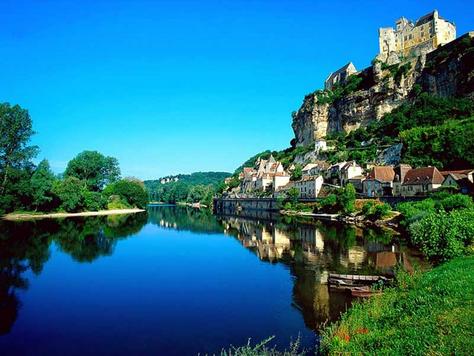
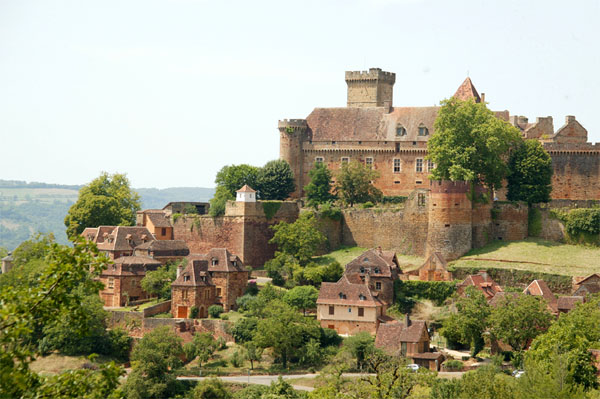
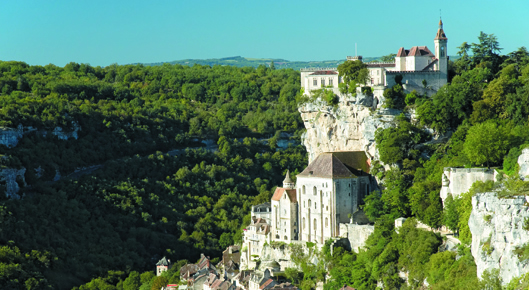
We've never quite made it to the Dordogne, but it has fascinated us for years. We are staying in the very beautiful (I'm told, Sarlat) for a couple of days, where we will drive around admiring the fantastic countryside and architecture, sampling the regional food and wine...


Map showing the Dordogne

SARLAT (pronunced SARLAH)

A big attraction of Sarlat and nearby towns is the caves nearby with prehistoric paintings. The most famous is Lascaux, which is closed to the public. The French have constructed a replica named Lascaux II near the original. The only actual painted cave open to the public, or at least to 200 of them per day, is Grotte de Font-de-Gaume. Our guide, Philippe Mouret, was able to obtain tickets to both Lascaux II and to Font-de-Gaume.


Lascaux, won't it be wonderful to see these (reproduced) paintings
The paintings are truly remarkable. The folks who painted them used torches for illumination and wooden scaffolding to reach the ceiling of the cave, and combinations of minerals to create various colors. They painted animals utilizing the contours of the cave walls. The paintings are fairly large, with the largest animal being 15 feet long. They painted some animals at a 45-degree angle, not just in profile. And, they did this up to 18,000 years ago! Compare this with the builders of the Egyptian pyramids (6000 years ago), the New Testament writers (2000 years ago) and the writers of the US declaration of independence (225 years ago).


Foie gras anyone?

Sarlat is also famous (or infamous) for pate de foie gras. This translates to paste of fat liver. Farmers around Sarlat force-feed geese to enlarge their livers, which are then served as a delicacy. Another specialty of the area is truffles.

More information on the Dordogne,..

Monday, May 9, 2011

Death in the Dordogne, by Louis Sanders

Well, any book on France catches my eye, whether fiction or non-fiction, I grab them all with greedy passion. However, maybe I'll be sorry I found this one at my local library.

I'm preparing for a trip in a month where I am going to drive around the Dordogne region of France, probably the last region I haven't explored. Well, not just the Dordogne - I will then head to the South of France via Toulouse and Carcassone, before swinging up to Andorra and Northern Spain.

Anyhow...my point...I've just finished reading Death in the Dordogne. How did Sanders get the French Ministry of Culture (Centre National du Livre) to assist in its publication. It paints a pretty bleak picture of the Dordogne - the cold, the rain, the bleakness, the War, the Resistance (the French don't call it the Resistance), the murders, the odd people - locals and expats. Well, it wouldn't make me want to go there if I hadn't read all the other glowing tomes. As the blurb says, it's not "A Year in Provence.'


This is the Dordogne I hope to discover.
Here's a couple of short reviews:

The February weather may be dark and dismal, but the locals provide plenty of colour as "a newly installed Englishman" in rural southern France copes with odd neighbors (a secretive doctor, a reclusive Dutch woman, a goat-breeding English alcoholic) and odder fatal accidents in Louis Sanders's engaging debut, Death in the Dordogne, translated by Adriana Hunter. The genial narrator, lacking anything better to do, busies himself with investigating, and he turns up old grudges that lead to new crimes in the first of a series.


When you moved to France to a picturesque hamlet in the Dordogne no one said it would be like this in February: freezing cold, dark by mid-afternoon and so quiet. Members of the Caminade family keep dying in suspicious circumstances, and the doctor knows more about it than he's prepared to reveal…. Slyly funny and delightfully laconic, Death in the Dordogne is the perfect accompaniment for anyone thinking about a holiday in France! (Ya think?)

I've since discovered Louis Sanders is an editor at a publishing house and he now lives in rural France in the Dordogne with his English wife. I figure the reason he wrote such a bleak tale of the Dordogne is that it is already full of the English and he wants to stop the influx! Maybe I can track him down and ask him. He's supposed to be writing a series, the lucky dog!

Go to this link for more info...


Tuesday, April 26, 2011

Troyes in France. First stop after Paris. What a gorgeous city! Reprint of my A - z Challenge entry.

Sorry I've been away so long, but with my writing, then participating in the A - Z Challenge where I've been blogging every day on my travel blog, I've been slow getting back to Paris! And on June 16 I'm heading back to Paris, then travelling for a month. What exciting stories I'll have to tell you then.

Anyway, for the T in the A -  Challenge I wrote about Troyes in France, a little south of Paris, in the Champagne Region. To kick off PichetsinParis again, I thought I'd reprint my post here. Enjoy...


Map of France showing the Champagne Region with Troyes in the South-West

When I first hit France in 2004, I was on a mission to get to Italy. Sounds crazy, but Aussie travellers are crazy. After over 20 hours on a plane to reach civilization (((snicker, snicker))), we hit the road running, or speeding, whatever. So after ooing and aahing as the plane hovered over Charles de Gaulle Airport, our schedule meant we had a rugged drive ahead to get to a little hill town north of Rome. Well, why didn't we fly into Rome then? Well, there was a reason but I quite forget now!


Champagne Region. See Troyes in the South West. (We got back to Champagne in 2008 where we visited many of the other Champagne towns and drank lots of, yeah, you got it...)

Anyhoo, tiredness set in as it does when you've been in a plane for a day, so we we managed to find our way out of Paris after only one wrong turn, then found the A-whatever, and headed south. No fun navigating as night set in along with jet lag, so where to lay our weary heads? Oh, there on the map, an interesting little town, Troyes, let's investigate. (Even though our itinerary was micro-managed by our travel agent, she had forgotten to book us in anywhere on our first night!) We brought her flowers when we returned...

After driving round and round looking for the actual city, we finally hit paydirt and stumbled upon the medieval centre. Woo hoo. We like old stuff. I guarded the car while the hubs found us a room at the inn, or the Best Western whatever. Well, what do you know? Oui, oui, tres possible.

Our first night in France was spent in a hotel right in the medieval centre and the badly-maligned French staff couldn't do enough to help travel-weary Aussies - "Have another bottle of Evian, s'il vous plait." I thought they'd be tu-ing us before too long. Desole, our dining room is closed, but there is a good Chinese down the road - (((guffaw))). So our first meal in France was Chinese. Ah, such a global society! It was tres delicious so not complaining.

We staggered to bed (you know you can't get a decent wine in a Chinese restaurant, must have been all that Evian) and slept the sleep of the blissfully happy.

Ah, but next morning we really knew what happiness was! Hitting the cobblestone streets, we were blown away by the picture-postcard perfection (yes, it brings out the poet in me) of a medieval town dusted in icing sugar snow, with happy Christmas music wafting through the chilly air. Yes, Aussies also like to hit Europe at Christmas to escape the oven that is Australia at that happy time. We like to experience a 'white' Christmas once in our lives with not a prawn or a bbq in sight for once!


So, after ordering a petit dejeuner in a delightfully authentic bistro, with all these French people (((ha ha))) and little silver trays with bills, money, whatever - where's the Euros?, I was able to use my recently-revised French language skills on the uber-efficient waiter. It all worked so seamlessly that the hubs (who speaks only Strine) didn't even know I'd ordered until bowls of steaming cafe au lait and croissants came winging out way and were plonked without ceremony on the timbered table. Ah, who has tasted more delicious coffee or croissants? They tasted like nectar to a couple of starving Aussies.


Petit dejeuner over with, let's hit the streets. Bit bumpy these cobblestones and it doesn't help that they've been dusted with snow overnight, but how completely exotic! Instead of donning the bikini and hitting the waves, here we are rugged up in overcoats, boots, scarves, gloves and beanies, walking up streets of half-timbered houses which looked like they could topple any minute, all accompanied by dulcet tones of French music. Oh la la. France stole my heart that magical morning in Troyes.

Finding Troyes was just the beginning of a red-hot love affair that rages on...

Here are some of the delights of Troyes. Every time we have a rave to a French person, telling them about our Troyes' experience, they look blank. Reason? Recently found out they pronounce it Trwah and were too polite to tell us!

Here's the blurb:

Troyes (pronounced trwah), was once a center for stained glass and textiles. It was also the home of the 12th-century poet Chrétien de Troyes, who wrote versions of the Arthurian legends, and of andouillettes, sausages, made in Troyes from tripe and famous throughout France.


The many cobblestone, pedestrians-only streets in the town's historic center give Troyes an intimacy that belies its population of over 60,000. An outline of the city looks like a Champagne cork with the medieval and artisanal vestiges mostly in the St.-Jean quarter at the base, and the administrative and ecclesiastical center at the head.

Go here if you'd like to learn more abou this gorgeous place.

Denise<3


Friday, March 18, 2011

Sitting at a typewriter and opening veins...


There's nothing to writing. All you do is sit down at a typewriter and open a vein.                        -Red Smith

That's what I'm doing for the next month, opening veins. Sorry, I won't be posting, but I will visit occasionally. I'll be back early April.

I have a lot of writing to do before I embark on my month-long sojourn in mid-June to Paris, the Dordogne, S.W. France, Andorra, San Sebastian Spain, Bordeaux, Morocco, Paris...


Tuesday, March 15, 2011

Murder in the Palais Royal

I just finished reading a detective book, Murder in the Palais Royal, by Cara Black. How come I haven't heard of her before? Have you? I discover that she's written a whole series of Murder in...
There's:
  • Murder in the Marais 
  • Murder in Belleville
  • Murder in the Sentier
  • Murder in the Bastille
  • Murder in Clichy
  • Murder in Montmarte
  • Murder in the Ile Saint-Louis
  • Murder in the Rue de Paradis
  • Murder in the Latin Quarter
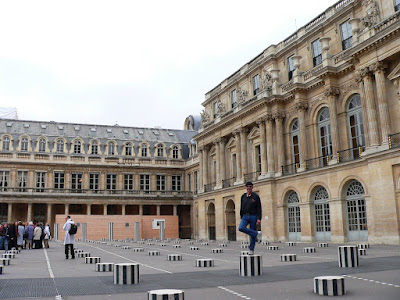
So why did I list them all? So I have a record for when I'm looking for another. I feel quite happy that I know all these areas, which is the reason I enjoyed Murder in the Palais Royal so much. I remember spending a pleasant day there, part of my search for the Paris Collette. At the time the fountain was frozen so that was a treat. It was also fun getting photos of the 260 columns of black-striped sculptures by  Daniel Buren which are described in the book.

These books have as their heroine P.I. Aimee Leduc - fearless, risk-taking, all the while dressed in vintage Chanel and Dior and Louboutin heels. I was impressed how she went shopping for vintage shoes while she was facing being arrested for murder! A unique heroine alright!

MURDER IN THE PALAIS ROYAL begins when Aimee Leduc, sharing some, ahem, quiet moments with her newest boyfriend, Mathieu, receives a call from her partner, Rene Friant. One hundred thousand francs have been deposited into the Leduc Detective Agency bank account. Regrettably, no one owes them so much money and Rene is afraid Aimee has done something less than legal. A short time later, Rene is shot and Aimee is the principal suspect...
USA Today says: "No contemporary writer of noir mysteries evokes the spirit of Paris more than Cara Black in her atmospheric series..."


Very true. The stories are pure escapism, a little weak on plot, but tres enjoyable.

Pick one up if you can.
href="http://blo64rt.blogspot.com/">